Tap Light
A rechargeable tap light for room decoration, developed around a 45 mm round PCB — four LEDs, a 300 mAh cell and USB-C charging, switched between two brightness levels by tapping it.
This page shows the product and the numbers behind it. It is one of our own projects, not client work.
Overview
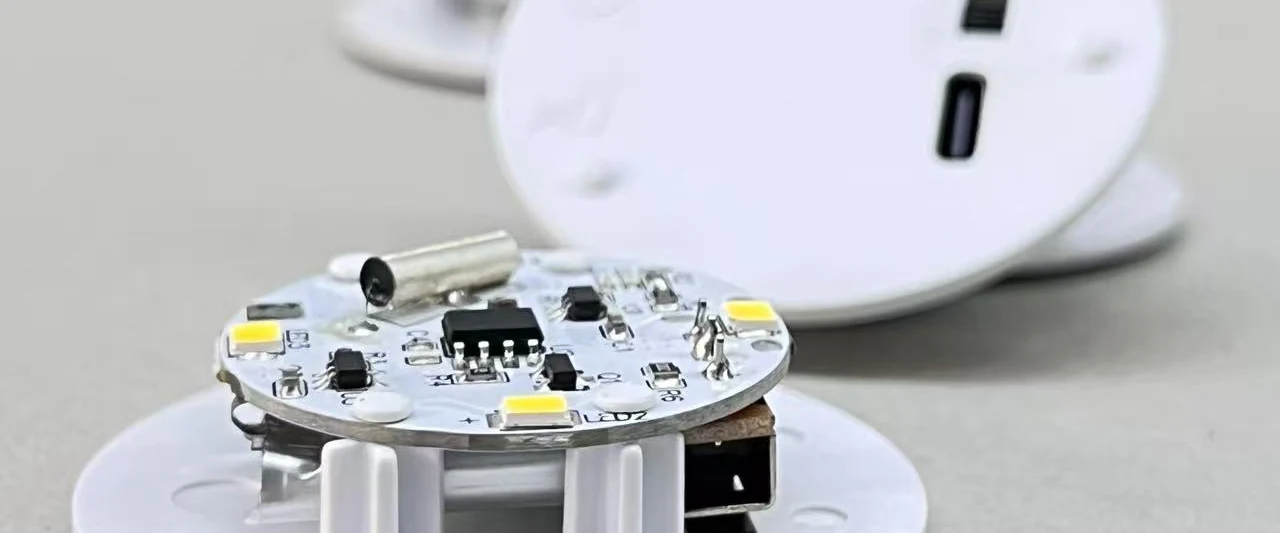
This is the base of a small tap light for room decoration — the part that carries the electronics: the round PCB, the battery and the charging port. The base itself measures 45 × 45 × 13 mm, in PP plastic with a matte finish.
There is no switch to hunt for in the dark. The button powers the light on, and from there a tap on the top cycles it between the two brightness levels: 50%, then 100%, then back again.
Specifications
| Item | Value |
|---|---|
| Base dimensions | 45 × 45 × 13 mm |
| Enclosure | PP plastic, matte finish |
| LEDs | 4 × 2835 |
| Light output | 26–28 lm |
| Colour temperature | 2800–3000 K (warm white), or cool white |
| Colour rendering | CRI 80 |
| Brightness levels | Two — 50% and 100%, cycled by tapping |
| Power | 1.5 W |
| Operating current | 75 mA |
| Input | 5 V |
| Output | 3.7 V |
| Battery | 702025, 300 mAh |
| Runtime | Up to 8 hours |
| Charging port | USB Type-C |
| Charging time | 45–50 minutes |
| Compliance | Built to FCC, EMC and UL requirements |
How it works
- Switch on
The button on the base powers the light on. Everything after that is done by tapping the product.
- First tap — 50%
A single tap brings the light up to half brightness, which is the level most people will use it at.
- Second tap — 100%
A second tap takes it to full brightness. Further taps cycle back to 50% and up again.
- Charging
The USB Type-C port charges the 300 mAh cell in roughly 45 to 50 minutes.
What we coordinated
- Product definition — a rechargeable room decorative light, taken from the requirement to a buildable specification
- Electronics design — schematic, PCB layout and firmware built around a Nyquest microcontroller
- Enclosure and structure — a PP housing with a matte finish
- Component sourcing — every component on the board purchased by us
What was tested
- AOI — automated optical inspection after assembly
- ICT — in-circuit test on the assembled board
- FCT — functional test. The board is powered up and exercised as a working unit rather than checked part by part: it has to switch on, answer a tap, step through both brightness levels and take a charge. Inspection can pass a board that still does not work — this is the step that catches it.
- Burn-in — the units powered continuously for an extended period. A board that works as it leaves the line can still fail in its first hours of use: an intermittent joint, a marginal component, a cell that will not hold up. Burn-in screens those out — intermittent faults and early component failures — before the product reaches a customer, rather than after.
Related services
Electronics Product Development
How we take a product from requirements through engineering, PCB, enclosure, assembly and testing.
See how we develop a productPCB Design
Schematic, layout and design-for-manufacturing review, handed off cleanly to assembly.
See PCB designPCBA Manufacturing
Fabrication, components, SMT and through-hole assembly, testing and QC, coordinated end to end.
See PCBA manufacturingCommon questions
-
How long does it run on one charge?
Up to 8 hours on a full charge. That is the upper figure for this product — how long it lasts in practice depends on the brightness level you use it at.
-
Can I buy this tap light from you?
This page shows the engineering, not a shop. It is a product we developed; if you want something built to your own requirements, send us the requirement and we will tell you honestly what is possible.
-
Can it be made in a different size or brightness?
The dimensions and LED configuration listed here are what this version uses. A different size, output or battery life is a new development question rather than a variant we can quote off the shelf — send us the requirement and we will assess it.
Have a product like this in mind?
Send your files — or just a rough idea. We'll review your project and tell you the next step.
No files ready yet? That's fine — start the conversation and we'll tell you what's needed.